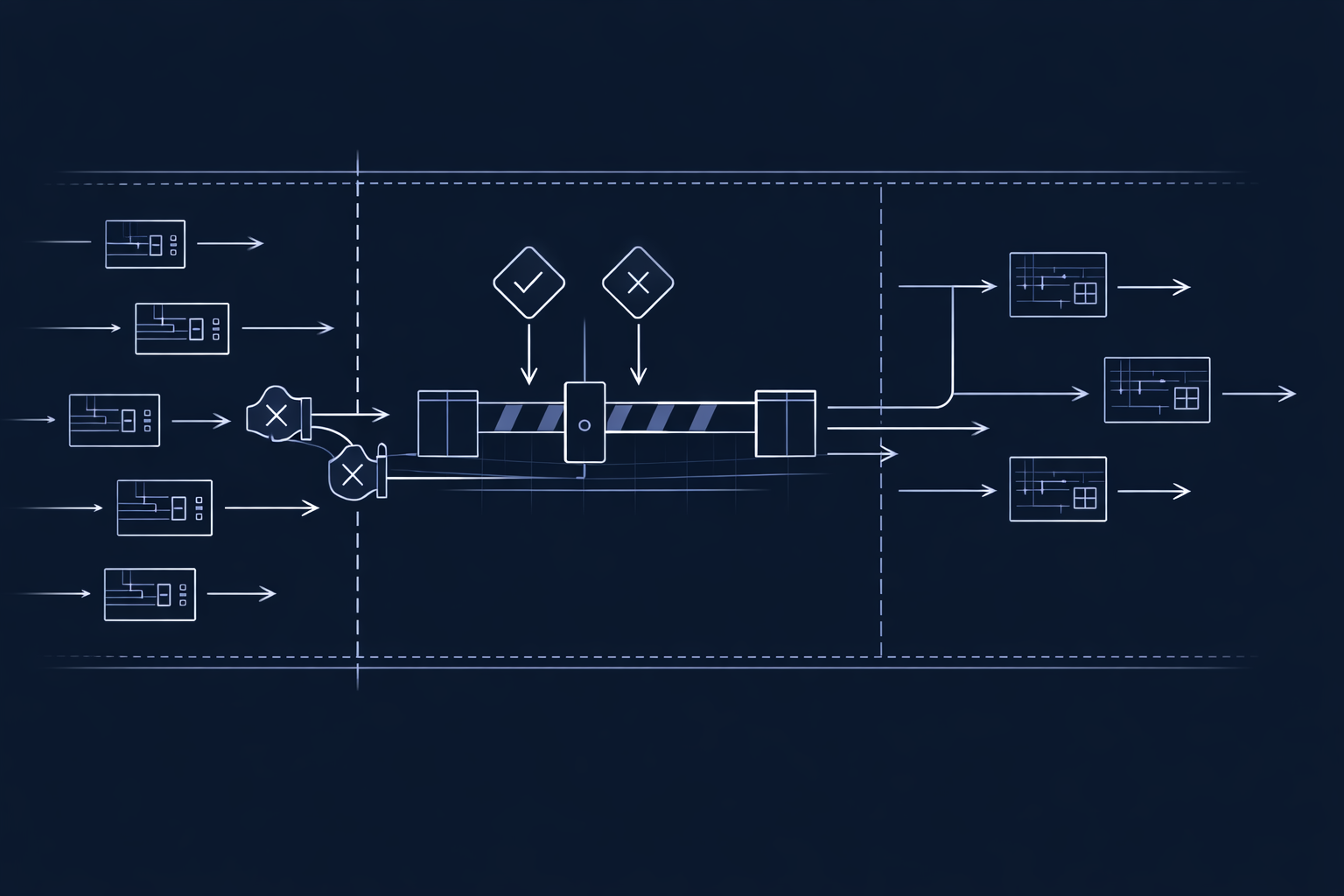
Modern AI agents, background workers, and automated execution systems are increasingly capable of planning, reasoning, and autonomous action. What most systems still lack is a simple, enforceable rule that determines whether execution is permitted at all.
This gap is not a tooling problem or a framework limitation. It is an enforcement problem. Without a hard gate at startup, execution becomes advisory rather than controlled.
The Enforcement Invariant
Effective control begins with a minimal invariant:
- An execution surface must be explicitly registered
- Permission must be validated at startup
- Work may proceed only if validation succeeds
If validation fails, execution must not begin. There are no partial states, retries, or degraded modes. The system either runs, or it does not.
This invariant is intentionally simple. Its value comes from being enforced consistently and externally, not from complexity.
Why Tokens and Prompts Are Not Enough
Many AI systems rely on API keys, prompt instructions, or internal policy checks to govern behavior. These mechanisms authenticate requests or influence decisions, but they do not reliably prevent execution.
Once an agent process starts, tokens and prompts rarely provide a decisive point of control. A misconfigured agent, leaked credential, or runaway loop can continue operating even after intent has changed.
Enforcement must occur before execution begins, not during or after. Startup validation is the only point at which execution can be definitively permitted or denied.
Device-Level Enforcement
MachineID treats every execution surface as a device with an identity. An agent instance, worker process, background job, or event consumer is not trusted by default. It must register and validate before it is allowed to run.
This model applies regardless of language, framework, or deployment environment. The enforcement decision exists outside the execution logic itself, preventing agents from self-authorizing or bypassing controls.
Limits become real because they are enforced at the only point that matters: startup.
Why Enforcement Must Happen at Startup
Consider a simple example. Three agent instances are permitted to run. Each registers and validates successfully. A fourth instance attempts to start.
If enforcement occurs at startup, the fourth instance fails validation and never executes. It cannot perform work, join a swarm, or consume resources. The system remains within its defined boundaries.
If enforcement is deferred, advisory, or internal to the agent, limits become negotiable rather than absolute.
Execution Surfaces Beyond Agents
This model is not limited to AI agents. Any system that performs work benefits from the same invariant:
- Background workers
- Scheduled jobs
- Event consumers
- Webhook processors
- Edge runtimes
Each represents an execution surface that should be explicitly registered and validated before running. Treating these surfaces as devices allows enforcement to scale across the entire system.
Separating Execution from Authority
A critical property of this approach is separation. Execution systems do not decide whether they are allowed to run. Authority lives outside the process.
This separation enables external control, revocation, and auditing without modifying or redeploying execution logic. It also prevents agents from continuing work after authorization has been withdrawn.
Register. Validate. Work.
The strength of this model lies in its clarity. There is no ambiguity about when execution is permitted. There is no reliance on internal discipline or best-effort checks.
Systems either register and validate successfully, or they do not run.
MachineID exists to provide this device-level enforcement layer for AI agents and execution systems, enabling real control through a simple and enforceable invariant.