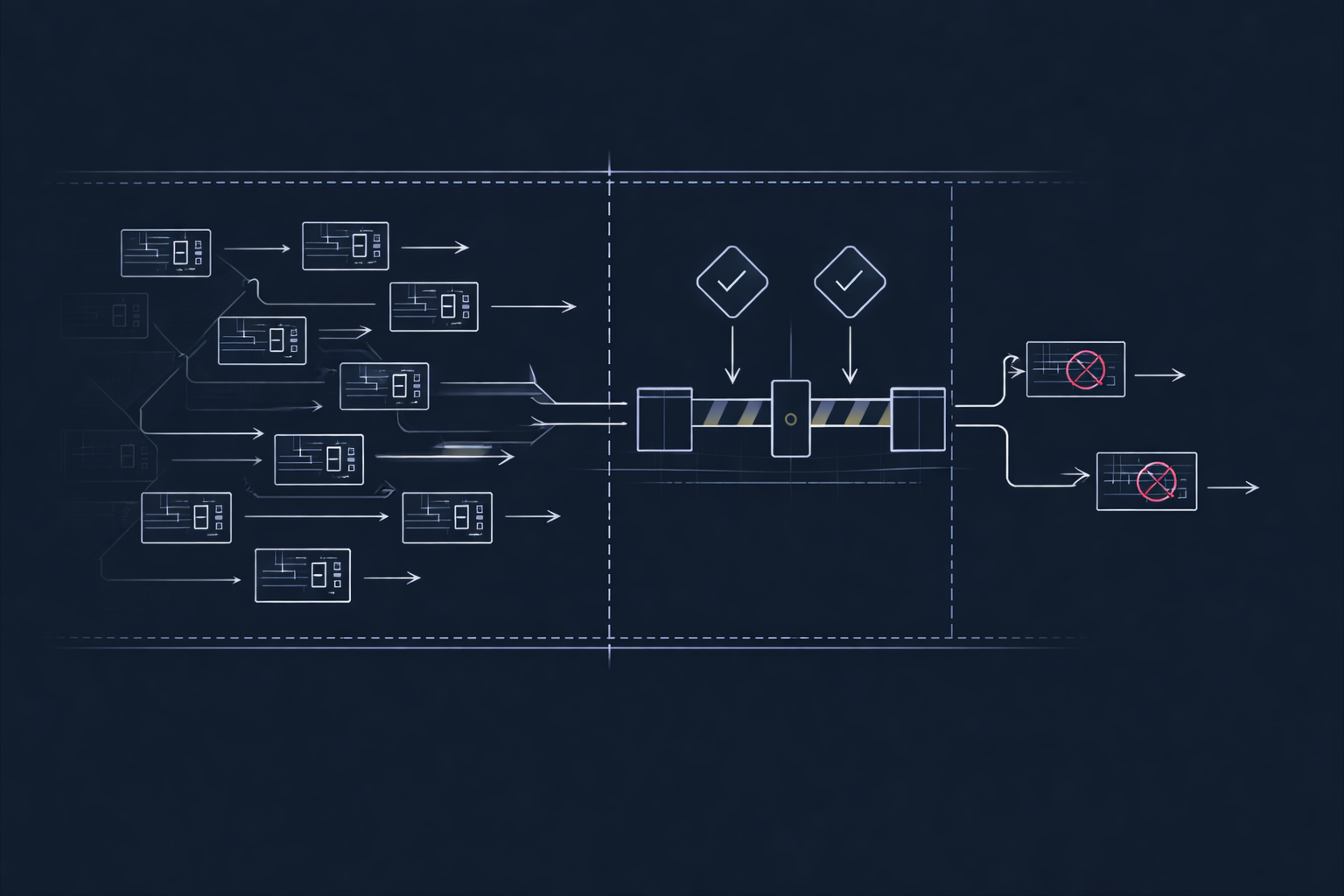
When AI agents behave unexpectedly, the first instinct is often to look at prompts, tools, or orchestration logic. These are important components, but they are not where real control failures occur.
Runaway agents are not primarily a reasoning problem. They are an infrastructure problem.
What “Runaway” Actually Means
A runaway agent is not necessarily malicious or incorrect. More often, it is simply executing beyond its intended scope:
- Continuing to operate after it should have been stopped
- Spawning additional instances without authorization
- Consuming resources indefinitely
- Acting on stale or revoked intent
In all of these cases, the agent is doing exactly what the system allows it to do. The failure lies in the absence of a hard execution boundary.
Orchestration Is About Flow, Not Permission
Orchestration frameworks excel at managing flow: deciding what should happen next, coordinating tools, handling retries, and persisting state. They are not designed to be enforcement systems.
Orchestration answers questions like:
- What task should run next?
- Which tool should be called?
- How should failures be handled?
It does not answer the most important question:
Is this allowed to run at all?
Prompts Do Not Enforce Boundaries
Prompt instructions and system messages influence behavior, but they do not create enforceable limits. An agent cannot be reliably stopped by telling it to stop.
If an agent process is already running, it retains the ability to continue work unless something external prevents it from doing so.
The Missing Layer: Execution Control
True control exists below orchestration and above raw infrastructure. It is the layer that decides whether execution is permitted in the first place.
This layer must be:
- External to the agent
- Enforceable at startup
- Capable of revoking permission at runtime
Without this layer, limits are advisory and best-effort.
Why Startup Enforcement Matters
Startup is the only moment when execution can be definitively blocked. If an agent fails validation at startup, it never begins work. There is no partial state and no cleanup required.
This is how growth becomes controllable. Additional agents that are not authorized simply do not run.
Why Runtime Revocation Matters
Startup enforcement alone is not enough. Systems also need the ability to stop execution that is already in progress.
Runtime revocation provides this capability. When permission is withdrawn externally, the execution surface loses the right to continue work.
This is not orchestration. It is enforcement.
Infrastructure Problems Require Infrastructure Solutions
Runaway agents persist because systems rely on cooperative control mechanisms. Agents are expected to obey prompts, respect configuration, or follow framework rules.
Infrastructure does not rely on cooperation. It enforces boundaries.
By treating agents and other execution surfaces as devices that must register, validate, and remain authorized, systems gain real control over execution.
Control Is a Property of the System
Whether an agent runs is not a property of the agent. It is a property of the system that hosts it.
When control is implemented as infrastructure rather than logic, runaway behavior becomes a preventable condition rather than an operational surprise.
MachineID provides device-level enforcement for AI agents and execution systems, enabling infrastructure-level control where orchestration and prompts fall short.